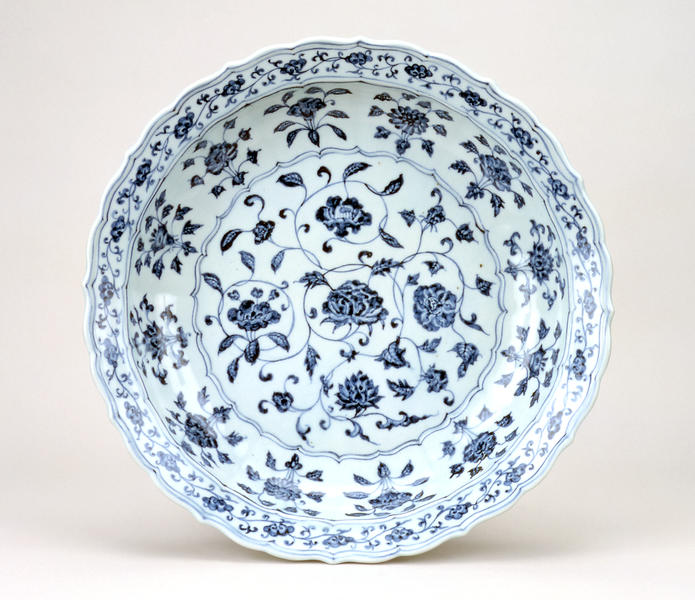
青花牡丹唐草文輪花皿
- 中国
- 中国・明時代
- 14c
- D-37.6
- 所蔵
- 出光美術館蔵
作品解説(エジプトのイスラーム文様)
青花牡丹唐草文輪花皿
中国 明時代・洪武(1368-98)
径37.6cm
出光美術館
中国から輸出された貿易陶磁器の種類は、14世紀になって、浙江省の越州窯や龍泉窯の青磁から、江西省の景徳鎮で製作された青花白磁へと大きな変化を遂げた。白色のキャンバスの上を鮮やかなコバルトブルーの文様で埋め尽くした元代の青花白磁は、まさに中近東の人々の嗜好にかなった陶磁器であった。元代に使われたコバルトは「回青」と呼ばれ、はるばる西方から中国に輸入されたものである。以後中国からの輸出陶磁器の主流は青花白磁になり、明末から清初にかけての動乱期を除いて莫大な量の青花白磁が世界中に輸出された。そのことは、中近東各地の遺跡で出土した膨大な量の青花白磁が如実に物語っている。
Catalogue Entry
Foliate-rimmed Dish with Design of Peony Scrolls
China, Ming dynasty, Hongwu period (1368-98)
Dia. 37.6 cm
Idemitsu Museum of Arts, Tokyo
A major change in Chinese export trade wares took place in the 14th century when there was a shift away from the celadons produced at the Yuezhou and Longquan kilns of Zhejiang province to the underglaze blue porcelains of the Jingdezhen kilns of Jiangxi province. The underglaze blue porcelains of the Yuan dynasty, with their vivid blue designs filling the white ground were a favorite type of ceramic ware for the people of the Middle East. The cobalt blue used in the Yuan dynasty wares was called "huiqing" and it was imported into China from the distant west. After the 14th century underglaze blue porcelains became the principal export trade wares for China. Except during the confused period of transition from the late Ming into the early Qing dynasty, massive numbers of underglaze blue porcelains were exported world-wide. This massive export program is fully visible in the huge number of underglaze blue porcelains excavated at sites throughout the Middle East.